Showing posts with label Nietzsche. Show all posts

Sunday, March 1, 2015

Nietzsche's Individualism

When a traveler who had seen many lands and national and several continents was asked what characteristic he discovered to be common to all of humanity, he replied: "They have a tendency toward laziness." To many it will seem that his reply would have been more accurate and valid if he had said: "They are all fearful. They hide behind customs and opinions." At bottom, every human being knows perfectly well that he lives in the world just once, as a unicum, and that no coincidence, regardless how strange, will ever for a second time concoct out of this amazingly variegated diversity the unity that he is. He knows this, but he conceals it like a bad conscience. Why? Out of fear of his neighbor who demands convention and who cloaks himself with it. But what is it that forces the individual to fear his neighbor, to think and act like a part of a herd instead of taking pleasure in being himself? Modesty, perhaps, in a few rare instances. In most instances it is convenience, indolence--in short, that tendency toward laziness of which the traveler spoke. He is right: human beings are lazier than they are fearful, and what they fear most are those hardships that unconditional honesty and nakedness would foist upon them. Artists alone despise this lethargic promenading draped in borrowed manners and appropriated opinions, and they expose the hidden secret, everyone's bad conscience, the principle that every human being is a one-of-a-kind miracle. They dare to show us how every human being, down to each movement of his muscles, is himself and himself alone; moreover, they show us that in the strict consistency of his uniqueness he is beautiful and worthy of contemplation, as novel and incredible as every work of nature, and anything but boring. When the great thinker disdains human beings, it is their laziness he disdains, for it is laziness that makes them appear to be mass-produced commodities, to be indifferent, unworthy of human interchange and instruction. The human being who does not want to be a part of the masses need only to cease to go easy on himself; let him follow his conscience, which cries out to him: "Be yourself! You are none of those things that you now do, think, and desire."
(from "Schopenhauer as Educator" in Unfashionable Observations, p. 171-172)

Or in contemporary slang: do you.

Wednesday, February 18, 2015

On the Uses and Disadvantages of Geology for Life

I attended this lecture yesterday at the University of Oregon. Coincidentally enough, I have just started reading Nietzsche's second Untimely Meditation or Unfashionable Observation from which David Wood got his title: "On the Utility and Liability of History" in the Stanford translation, but also known in English as "On the Uses and Disadvantages of History for Life".

First, I want to say: Wood is steeped in contemporary Continental, particularly French, philosophy, and yet (despite that!) is a perfectly clear and comprehensible speaker. For that reason alone, I'm going to take a look at his books.

The gist of his talk was the promotion of "geological" thinking as a response to current environmental crises. While Wood looked analytically at such geological thinking--for instance, categorizing it into monumental, antiquarian, and critical variants as Nietzsche does for history--it does seem that Wood is more "pro" geology whereas Nietzsche was more "con" history. Wood did touch on the potentially oppressive and debilitating weight of geological consciousness, impeding action on environmental issues and much else. I believe that Wood felt himself to be offering a bit of an answer to such debilitation, but I also feel that I did not come away with one.

I don't know that "geology" was the most felicitous word to talk about a consciousness beyond the anthropometric. Also, a question I might have raised were there more time at the end: how to justify a focus on value at the level of the planetary? In opposition notably to that which is smaller: one's self, the nation, etc.  But also in opposition to that which is much larger: the cosmic. In view of the vastness of the universe, the fate of planet earth and its life seem to fade into true insignificance. This is a core question for Wood to address. Perhaps by making the case that there is (aesthetic?) value at each of these levels? He did mention the work of Delanda; it sounds like Delanda devalues the geologic from a cosmic perspective.

Overall, this lecture of just over an hour appeared to be a taste of a project in an early stage. I like Wood's style, his topics, and how he uses the thinkers he draws upon.

Monday, February 16, 2015

Nietzsche on the scholars

The essence of the scholarly person...is marked by a genuine paradox: he behaves like the proudest idler upon whom fortune ever smiled, as if existence were not something hopeless and questionable, but rather a firm possession guaranteed to last forever. He sees nothing wrong in wasting one's life with questions whose answers could be important to someone already certain of eternal life. Everywhere around this heir to a few meagre hours there yawn the most terrifying abysses; at every step he should be reminded to ask: Why and to what purpose? Whither am I going? Whence do I come? But his soul is set aglow at the thought of counting the filaments of a flower or of cracking open the stones along the path, and he sinks the full weight of his attention, joy, energy, and desire into this labor.

Having myself foresworn academia--and what has been harder, foreswearing being an independent scholar doing the sort of research that academics do (though these days, mostly in what passes as their free time)--to pursue my studies where they lead and to do my own creative work, I enjoy Nietzsche's bold words. Though in calm moments I have to admit that scholarship too is of great value--or can be. It can exhibit the scientific spirit of discovery. It can be creative. And it can be helpfully pedagogic. Of course, often it's not--it is churned out to fit the demands of "publish or perish"--and almost always is crafted within the very narrow confines of what's currently considered acceptable academic opinion. (Which often requires willfully misunderstanding texts from other eras and contexts.)

Apropos of "publish or perish", Nietzsche's next words are prescient:

Now, this living paradox, this scholarly person, has recently begun in Germany to work at such a frantic pace that one must imagine scholarship as a factory in which for every delay of mere minutes the scholarly laborer is punished. Nowadays he labors as hard as the fourth estate, the slaves; he labors, his studies are no longer a calling but an affliction, he looks neither to left nor to right and passes through all the matters of life, even through those that are questionable in nature, with that half-attention or with that odious need for rest and recreation characteristic of the exhausted laborer.

(Unfashionable Observations, p. 46, Stanford edition of The Complete Works of Friedrich Nietzsche, v. 2)


P. S. (Feb. 19):

Found the following a little further on in my reading (in "The Utility and Liability of History for Life"):

To those who tirelessly mouth the modern cries to battle and to sacrifice, "Division of labor!" "In rank and file!," we have to say clearly and bluntly: if you want to further scholarship as quickly as possible, just as the hen that you artificially force to lay eggs as quickly as possible also perishes. Granted, scholarship has been furthered at an astonishingly quick pace in the last decades, but just look at the scholars, the exhausted hens. They are truly not "harmonious" natures: they can only cackle more than ever because they are laying eggs more frequently. To be sure, the eggs have kept getting smaller (although the books have only gotten bigger).

Nietzsche on the tasks of writing

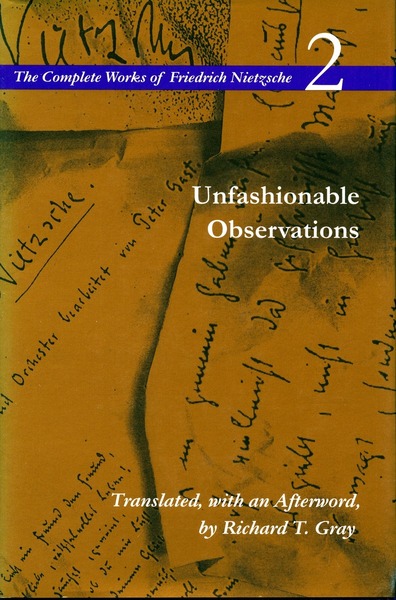
I'm reading Nietzsche's Unfashionable Observations, or what has been previously translated as the Untimely Meditations. The first of these is an extended, withering attack on one David Friedrich Strauss, who as far as I know has been completely forgotten outside of those who know about him through Nietzsche. I'm finding this essay to have a lot of contemporary relevance, because much of what Nietzsche attacked in German academia and culture in the 1870s holds true of American academia and (the tiny world of) intellectual culture today.

At this time Nietzsche was breaking free of the world of academic philological scholarship (quite possibly an unmooring and setting adrift as well). He sought to create original works worth studying, being inspired by the models of classical authors, rather than doing scholarship on the tiniest details of those classical authors as a comfortable (bourgeois!) profession (something academia no longer promises to be, but that's a story for other posts).

I liked the following quote:

Anyone who has reached his fortieth year should have the right to write an autobiography, for even the most insignificant person can have experienced and seen up close something that the thinker may find worthwhile and noteworthy. But to make a confession about one's beliefs must be considered incomparably more exacting, because it presupposes that the confessor ascribes value not only to what he has experienced, explored, or seen during his lifetime, but even to what he has believed.

As someone who has reached and even surpassed his fortieth year...

The knife in his quote is double-edged. But I will take the optimistic side of it: One who has reached "a certain age" (I don't know that there's anything sacred about forty, but, hey, it works) has experiences that are worth writing about. And even beliefs, if written about in a way incomparably more exacting.